Theme guide
Play
Images are examples only. Download the app to study the full theme with English as your guide.
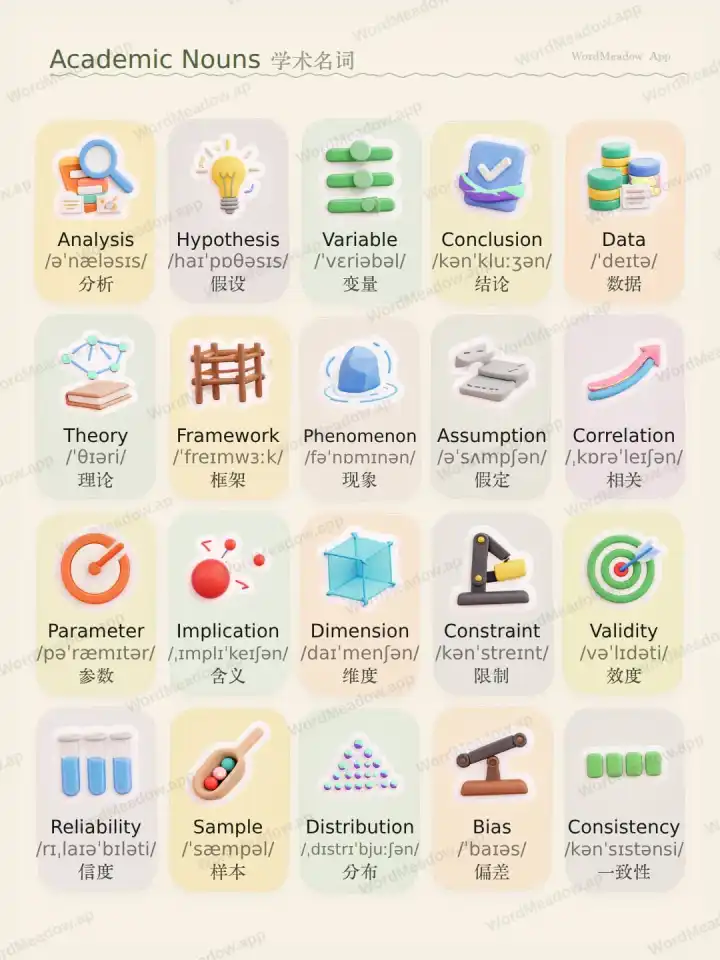
Theme video
学术名词 video
Watch this theme card with English guidance and Simplified Chinese vocabulary.Vocabulary list
Browse words, pronunciation, translations, and example sentences.分析
Analysis
她的分析显示睡眠和考试表现之间有明确联系。Her analysis showed a clear link between sleep and test performance.
假设
Hypothesis
这个假设在更大一组学生中得到了检验。The hypothesis was tested with a larger group of students.
变量
Variable
年龄是这项调查中的主要变量。Age was the main variable in the survey.
结论
Conclusion
报告得出的结论是这种方法有效。The report reached the conclusion that the method was effective.
数据
Data
这些数据支持新模型。The data support the new model.
理论
Theory
这个理论解释了为什么这种模式会反复出现。The theory explains why the pattern appears again and again.
框架
Framework
这个框架帮助团队清晰比较了不同结果。The framework helped the team compare different results clearly.
现象
Phenomenon
在线学习的兴起是一种全球现象。The rise in online learning is a global phenomenon.
假定
Assumption
这个模型依赖于价格保持稳定的假定。The model depends on the assumption that prices stay stable.
相关
Correlation
这项研究发现运动和情绪之间有很强的相关性。The study found a strong correlation between exercise and mood.
参数
Parameter
我们调整了参数来改进模拟结果。We adjusted the parameter to improve the simulation.
含义
Implication
这一发现的含义是还需要更多研究。The implication of the finding is that more research is needed.
维度
Dimension
这个项目为讨论增加了社会维度。The project adds a social dimension to the discussion.
限制
Constraint
时间是研究团队面临的最大限制。Time was the biggest constraint on the research team.
效度
Validity
这项测试的效度取决于它的设计方式。The validity of the test depends on how it is designed.
信度
Reliability
经过反复试验后,结果的信度提高了。The reliability of the results improved after repeated trials.
样本
Sample
研究人员从每个组中抽取了一个样本。The researchers took a sample from each group.
分布
Distribution
分数的分布并不均匀。The distribution of scores was not even.
偏差
Bias
如果问题带有诱导性,这项调查可能会有偏差。The survey may include bias if the questions are leading.
一致性
Consistency
测量的一致性让结果更有说服力。The consistency of the measurements makes the results more convincing.
Get the WordMeadow app for the full study flow
More themes, tap-to-listen practice, saved words, short readings, and spelling exercises come together in the app.
More themesListen and repeatSaved reviewSpelling practice
 Open on the App Store
Android is coming
Use the iOS version for now. The Android download entry will appear here when it is ready.