Theme guide
Play
Images are examples only. Download the app to study the full theme with English as your guide.
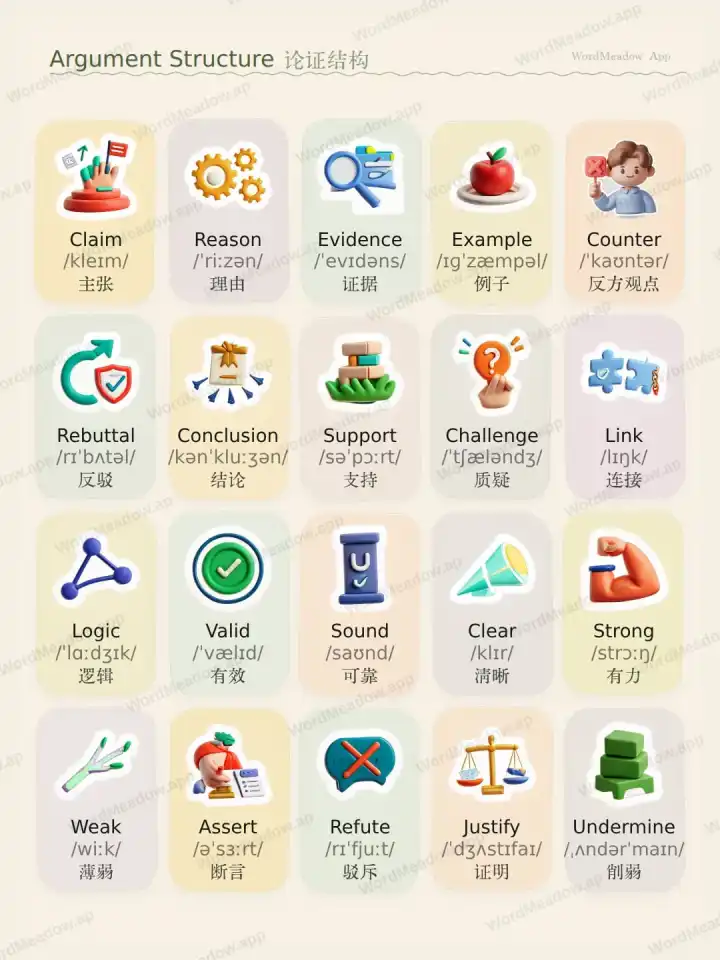
Theme video
论证结构 video
Watch this theme card with English guidance and Simplified Chinese vocabulary.Vocabulary list
Browse words, pronunciation, translations, and example sentences.主张
Claim
她的主张得到了三项独立研究的数据支持。Her claim was supported by data from three independent studies.
理由
Reason
这次改变的主要原因是缺乏可靠证据。The main reason for the change was a lack of reliable evidence.
证据
Evidence
律师提交了明显支持该主张的证据。The lawyer presented evidence that clearly supported the claim.
例子
Example
这份报告给出了一个说明薄弱论证如何改进的例子。This report gives an example of how a weak argument can be improved.
反方观点
Counter
演讲者用更简洁的解释回应了这个反方观点。The speaker offered a counter to the objection with a simpler explanation.
反驳
Rebuttal
她的反驳逐条回应了批评。Her rebuttal addressed the criticism point by point.
结论
Conclusion
结论部分概括了论证并重申了核心观点。The conclusion summarizes the argument and restates the main point.
支持
Support
新的调查支持这样一种观点:学生在反馈中学得更好。The new survey supports the idea that students learn better with feedback.
质疑
Challenge
这些数据质疑了“价格更高就一定质量更好”的假设。The data challenge the assumption that higher cost always means higher quality.
连接
Link
作者清楚地把练习和长期进步联系了起来。The writer made a clear link between practice and long-term progress.
逻辑
Logic
当关键事实被去掉时,这个论证的逻辑就站不住了。The logic of the argument breaks down when the key fact is removed.
有效
Valid
那是一个合理的担忧,因此值得直接回应。That is a valid concern, so it deserves a direct answer.
可靠
Sound
这个方案看起来很可靠,因为它建立在现实目标之上。The plan looks sound because it is based on realistic goals.
清晰
Clear
这个解释很清晰,所以听众能轻松跟上论证。The explanation is clear, so the audience can follow the argument easily.
有力
Strong
她有力地论证了应该修改这项政策。She made a strong case for changing the policy.
薄弱
Weak
这个论证很薄弱,因为它只依赖一个不确定来源。The argument is weak because it relies on one uncertain source.
断言
Assert
作者断言这些结果没有受到偏见影响。The author asserted that the results were not influenced by bias.
驳斥
Refute
这项研究驳斥了“这种方法没有效果”的说法。The study refutes the claim that the method has no benefit.
证明
Justify
团队试图用清晰的数据和结果来证明这个决定是合理的。The team tried to justify the decision with clear data and results.
削弱
Undermine
一个粗心的错误就可能削弱整份报告的可信度。A careless mistake can undermine the credibility of the entire report.
Get the WordMeadow app for the full study flow
More themes, tap-to-listen practice, saved words, short readings, and spelling exercises come together in the app.
More themesListen and repeatSaved reviewSpelling practice
 Open on the App Store
Android is coming
Use the iOS version for now. The Android download entry will appear here when it is ready.