Theme guide
Play
Images are examples only. Download the app to study the full theme with English as your guide.
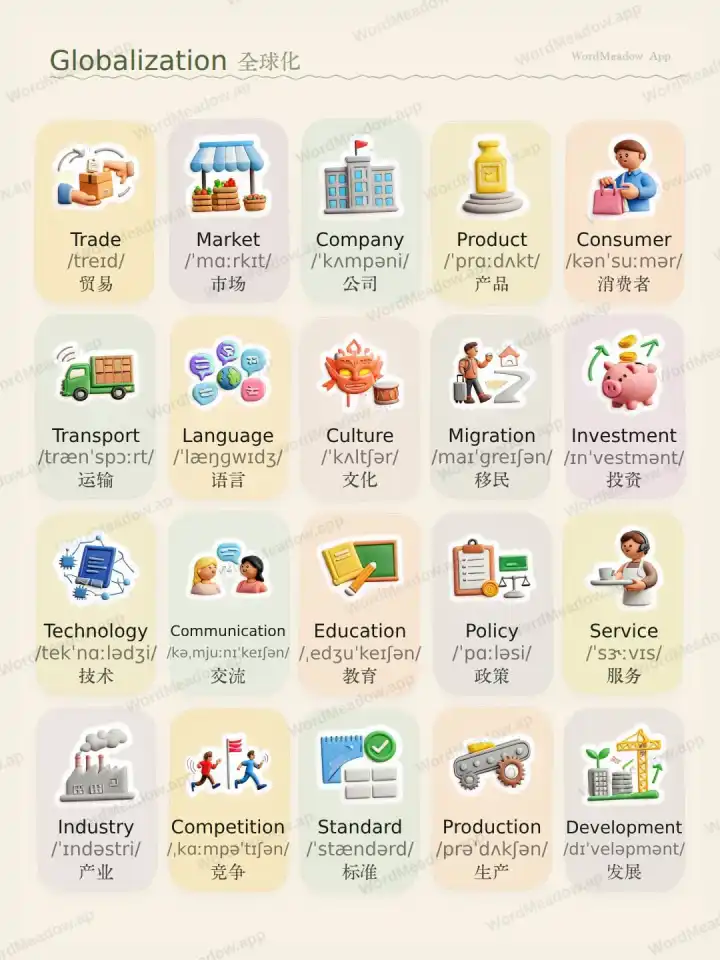
Theme video
全球化 video
Watch this theme card with English guidance and Simplified Chinese vocabulary.Vocabulary list
Browse words, pronunciation, translations, and example sentences.贸易
Trade
贸易把生产者和买家连接到国界之外。Trade connects producers and buyers across borders.
市场
Market
这家公司计划明年进入亚洲市场。The company plans to enter the Asian market next year.
公司
Company
这家公司把业务扩展到了海外。The company expanded its business overseas.
产品
Product
他们的新产品是为全球用户设计的。Their new product is designed for global users.
消费者
Consumer
消费者现在可以在线即时比较价格。Consumers now compare prices instantly online.
运输
Transport
高效运输有助于货物跨国流动。Efficient transport helps goods move across countries.
语言
Language
英语已经成为国际商业中的通用语言。English has become a common language for international business.
文化
Culture
全球化既会传播观念,也会改变本地文化。Globalization can spread ideas while also changing local culture.
移民
Migration
人口迁移塑造了许多全球城市。Migration has shaped many global cities.
投资
Investment
外国投资可以创造新就业并促进技术转移。Foreign investment can create new jobs and technology transfer.
技术
Technology
技术让全球交流更快也更便宜。Technology makes global communication faster and cheaper.
交流
Communication
数字交流缩短了团队之间的距离。Digital communication has reduced the distance between teams.
教育
Education
教育帮助人们适应变化中的世界。Education helps people adapt to a changing world.
政策
Policy
政府出台了一项新的贸易政策。The government introduced a new trade policy.
服务
Service
服务业在全球经济中扮演着越来越重要的角色。Service industries play a growing role in the global economy.
产业
Industry
本地产业依赖国际供应链。The local industry depends on international supply chains.
竞争
Competition
竞争推动公司提升质量并降低价格。Competition pushes companies to improve quality and lower prices.
标准
Standard
全球贸易通常需要相同的安全标准。Global trade often requires the same safety standards.
生产
Production
生产转移到了成本更低的国家。Production moved to countries with lower costs.
发展
Development
经济发展可以逐步提高生活水平。Economic development can raise living standards over time.
Get the WordMeadow app for the full study flow
More themes, tap-to-listen practice, saved words, short readings, and spelling exercises come together in the app.
More themesListen and repeatSaved reviewSpelling practice
 Open on the App Store
Android is coming
Use the iOS version for now. The Android download entry will appear here when it is ready.