Theme guide
Play
Images are examples only. Download the app to study the full theme with English as your guide.
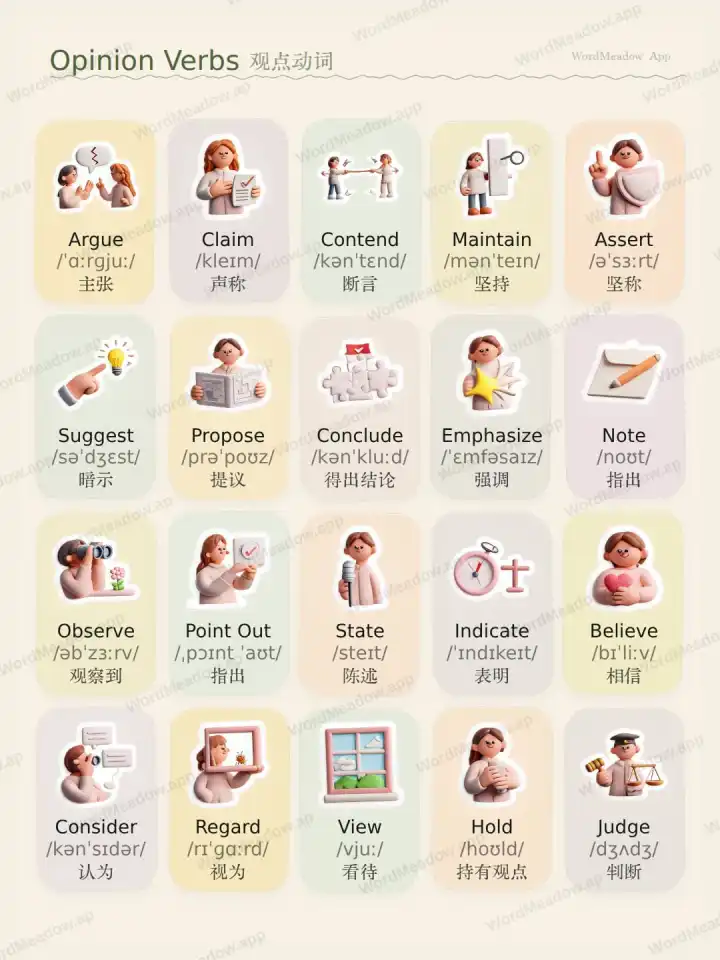
Theme video
观点动词 video
Watch this theme card with English guidance and Simplified Chinese vocabulary.Vocabulary list
Browse words, pronunciation, translations, and example sentences.主张
Argue
他们主张这个方案会节省时间。They argued that the plan would save time.
声称
Claim
这家公司声称产品经过了充分测试。The company claimed that the product was tested thoroughly.
断言
Contend
研究人员断言这些结果并不可靠。The researchers contended that the results were not reliable.
坚持
Maintain
她坚持说自己的答案是对的。She maintained that her answer was correct.
坚称
Assert
他坚称自己以前从未见过这份文件。He asserted that he had never seen the document before.
暗示
Suggest
这份报告表明需求明年可能再次上升。The report suggests that demand may rise again next year.
提议
Propose
她提议为这个项目制定新的时间表。She proposed a new schedule for the project.
得出结论
Conclude
法院得出结论,证据不足。The court concluded that the evidence was insufficient.
强调
Emphasize
老师强调了定期复习的重要性。The teacher emphasized the importance of regular review.
指出
Note
作者指出公众意见出现了明显变化。The author noted a clear change in public opinion.
观察到
Observe
科学家观察到这一模式每五分钟重复一次。The scientist observed that the pattern repeated every five minutes.
指出
Point Out
他指出那些细节被忽略了。He pointed out that the details had been overlooked.
陈述
State
发言人陈述该政策将保持不变。The spokesperson stated that the policy would remain unchanged.
表明
Indicate
数据显示这一趋势仍在持续。The data indicate that the trend is continuing.
相信
Believe
很多人相信小习惯会塑造长期的成功。Many people believe that small habits shape long-term success.
认为
Consider
我们认为这种方法最实用。We consider this approach to be the most practical.
视为
Regard
这本书被视为现代经典。The book is regarded as a modern classic.
看待
View
专家把这一变化看作积极信号。Experts view the change as a positive sign.
持有观点
Hold
她持有这样的观点:自由讨论能改善决策。She holds that free discussion improves decision-making.
判断
Judge
在看到完整报告之前,不该对结果下判断。You should not judge the result before seeing the full report.
Get the WordMeadow app for the full study flow
More themes, tap-to-listen practice, saved words, short readings, and spelling exercises come together in the app.
More themesListen and repeatSaved reviewSpelling practice
 Open on the App Store
Android is coming
Use the iOS version for now. The Android download entry will appear here when it is ready.