Theme guide
Play
Images are examples only. Download the app to study the full theme with English as your guide.
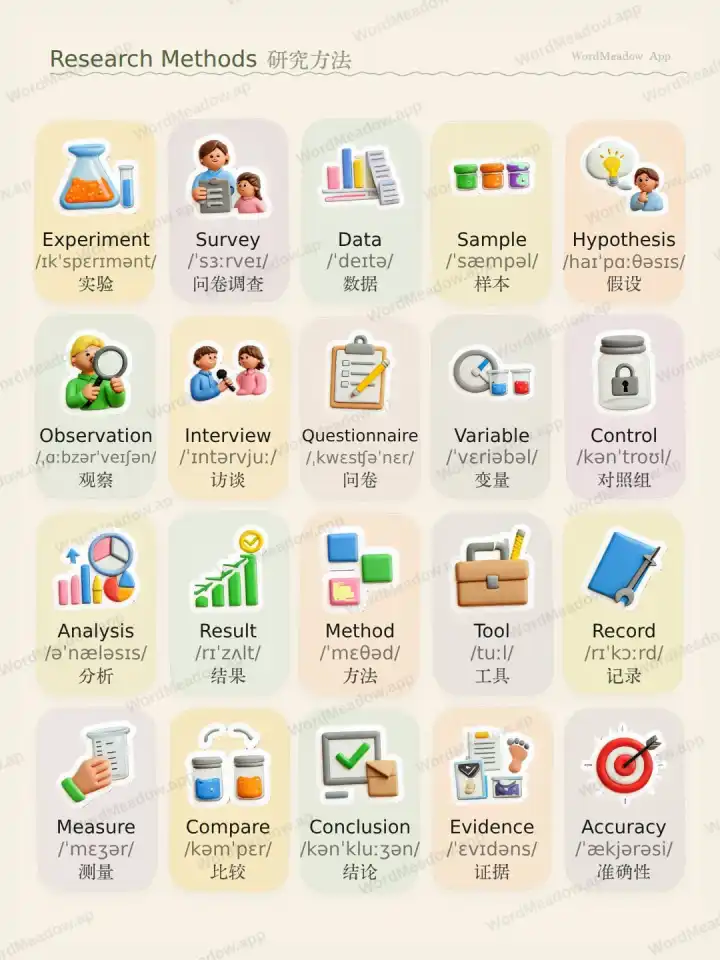
Theme video
研究方法 video
Watch this theme card with English guidance and Simplified Chinese vocabulary.Vocabulary list
Browse words, pronunciation, translations, and example sentences.实验
Experiment
学生们做了一个实验,测试阳光如何影响植物生长。The students conducted an experiment to test how sunlight affects plant growth.
问卷调查
Survey
学校做了一项关于学生阅读习惯的调查。The school carried out a survey about students' reading habits.
数据
Data
我们从三个不同的班级收集了数据。We collected data from three different classes.
样本
Sample
科学家检测了从河里取来的一份水样。The scientists tested a sample of water from the river.
假设
Hypothesis
我们的假设是,水温更高会加快反应。Our hypothesis was that warmer water would speed up the reaction.
观察
Observation
细致的观察帮助团队注意到行为上的一个小变化。Careful observation helped the team notice a small change in behavior.
访谈
Interview
研究人员采访了十位老师,了解课堂上的困难。Researchers interviewed ten teachers about classroom challenges.
问卷
Questionnaire
研究开始前,参与者填写了一份问卷。Participants completed a questionnaire before the study began.
变量
Variable
测试中的主要变量是光照量。The main variable in the test was the amount of light.
对照组
Control
对照组接受了常规处理。The control group received the usual treatment.
分析
Analysis
分析显示结果中有一个清晰的规律。The analysis showed a clear pattern in the results.
结果
Result
最终结果比我们预期的更好。The final result was better than we expected.
方法
Method
这种方法简单但可靠。This method is simple but reliable.
工具
Tool
显微镜是生物学中很重要的工具。A microscope is an important tool in biology.
记录
Record
请每小时记录一次温度。Please record the temperature every hour.
测量
Measure
我们用厘米测量了每张桌子的长度。We measured the length of each table in centimeters.
比较
Compare
这份报告比较了两组的考试成绩。The report compares the two groups' test scores.
结论
Conclusion
总之,数据支持了我们的假设。In conclusion, the data supported our hypothesis.
证据
Evidence
有充分证据表明这种新方法有效。There is strong evidence that the new method works.
准确性
Accuracy
这次测量的准确性很高。The accuracy of the measurement was very high.
Get the WordMeadow app for the full study flow
More themes, tap-to-listen practice, saved words, short readings, and spelling exercises come together in the app.
More themesListen and repeatSaved reviewSpelling practice
 Open on the App Store
Android is coming
Use the iOS version for now. The Android download entry will appear here when it is ready.